5 May 2016

Garden Visitors 2

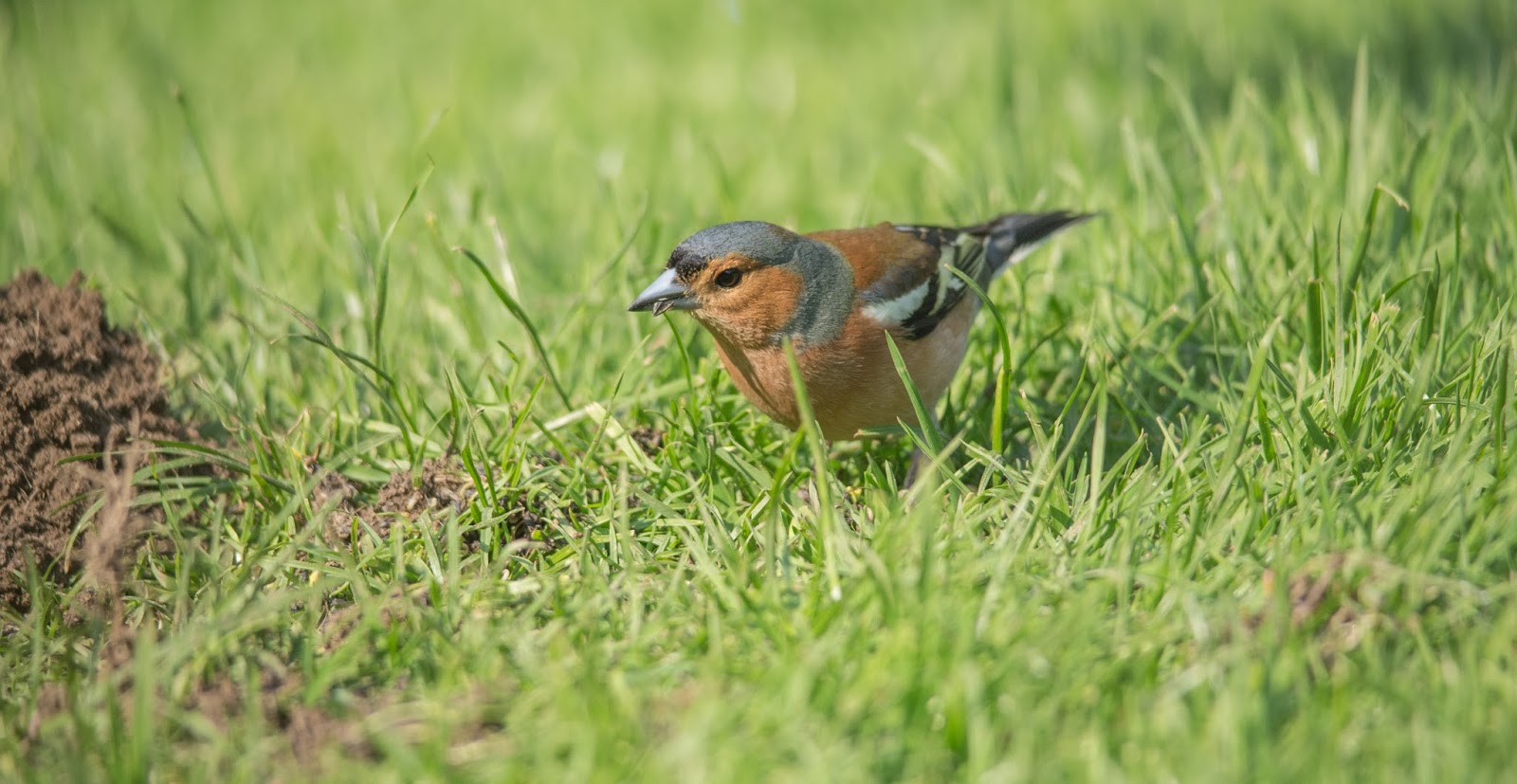
Following on from "Garden Vistors 1" and "The Rare Garden Visitors" Blogs, this documents the other visitors I have visit on a regular or daily basis. First is the well known Chaffinch. He and his partner spend quite a bit of time in the garden normally hanging around the Cherry Tree for security. These particular shots are quite close to the house on the lawn where some seed had been spilled.


Male Chaffinch


Next up the House Sparrow, used to be very common and frequently nest in our Eaves, then for some reason (as documented by specialists) numbers dropped significantly. The last 2 years has seen them returning and living in my neighbours Rhododendron. A group of around 10-20 spend there time in the Shrub and pop out to our feeder station constantly. I was lucky to get a stunning male once all fluffed up posing...


A right Poser...

All fluffed up

They are so expressive and a joy to watch with their splendid deep Red/ Brown colouration. I'm glad the numbers have increased in my area.

The Blackbird is a stalwart of British Gardens and as such in ours too. Thanks to territory wars each season I have been able to capture (if not perfect) some of this action going on.... It is very challenging to capture due to trying to get 2 birds in one frame and also with their Erratic behaviour too.


The first 2 in the sequence are from 31/5/2014 and the second 2 are just recent to my writing this on 20th January 2016. To get them pin sharp is very tricky but I love how the drama and violence is depicted through the motion in the shots. One of the males is actually pretty tame and just last summer he, his partner and 1 youngster were all tame and were happy to feed on the table on the patio just some 12ft away from me. The next 3 are of this family. The female is particularly petty with a light mottled breast patterning.


Father

Baby

Mother

They did have a second youngster but sadly it flew into the window and died. Such is life's balance!

On a lighter note, one of the most comical birds I watch is the Jackdaw. The way they move about, scrap with each other and generally get into mischief is just so enjoyable to witness. In the follow 2 photos, we had brush out the dead fur from our Border Collies and I thought as it was nesting time that maybe leaving it out in the garden would provide some activity. Sure enough, he landed not to far from it, looked around to see if it was clear, edged closer, looked again, edged closer, then went straight in, gathering as much as he could carry. He made 5 visits in the end clearing most of it and providing me with some footage too.


Sorry can't chat, got me mouth full!!!

 So this wraps up a few more of life in my garden. There are still plenty more for another Blog or 2 to follow.


10 Feb 2016

The Rare Garden Visitors

Over the last few years the garden has been full of diverse Wildlife. Among the common visitors there has been a few surprise visitors too. This Blog documents them I have captured on camera...


Blackcap 13/4/2013

Starting with the rarest and one time visitor. A Male Blackcap, that for just a morning fed on one of the few Peanut cages. The following year I saw one at my local lake (Seen in Eastwell Lake blog) so this may have been the same bird moving through the area.


Flycatcher 29/9/2014

Flycatcher 29/9/2014

Next to appear was a Fly Catcher. The bird darted about in this Shrub for 30 minutes or so. The next rare, well I say rare, but visits on and off hunting is a Male Sparrowhawk. I finally captured him with the camera February 2015 when he landed on top of the bird table. The piercing stare from his yellow eye clearly visible along with the pristine blue/ grey plumage down his back. Talons so dainty too that defy the image of a formidable hunter.


Male Sparrowhawk 24/2/2015


The latest bird to appear is a Tree Creeper on our Cherry Tree in the garden. He appeared on the 13 January 2016.


Tree Creeper 13/1/2016

Another venturer into the garden was a Red Legged Partridge. Previous to this and unseen by me about 9 had come in, but this occasion just the solo bird. I had 2 quick grab shots from hiding in the conservatory shooting through a very narrow gap in a bush and was lucky to get the following shots...


Red Legged Partridge (also known as French Partridge)

Another colourful bird to appear on the front garden was a female Green Woodpecker. They are normally seen out in the back field feeding on bugs or heard calling in the mid distant trees. There was a youngster around too, but was found dead several days later under our Kitchen window. We couldn't believe how we had 2 young bird deaths in one summer. We put it down to the male Sparrowhawk flying through and spooking them as he was common at this point! 


Feeding by front path

Green Woodpecker female

Last of the infrequent visitors was a Pied Wagtail also at the front of the house. He visited the small feed table we have at the Kitchen window for just 2 days. They are normally out on the village green but one felt brave and made a journey over in front of the row of houses we live in. I love the quirky movements they make, darting about so fast in sporadic directions. Not akin to the dainty design the bird has...


Pied Wagtail on front parking place
Lastly, well not actually in our garden, but flew over the bottom of it was a Red Kite in 2014. I was told by my neighbour of its location he had actually seen it after I said to him we saw it. So we proceeded there that very afternoon and was in luck as it did appear high in the sky. The first of the 2 is the grab shot of it from my bedroom window and the second, if still not great was at the location at Challock, Kent. In fact walking the dogs twice to Eastwell Lake and once in Kings Wood Challock, I have seen one on these occasions too. All when I had no camera with me! Doh!. And at the woods he was really close and low too... just to rub it in!


From Bedroom
 
Over Challock


Over the years we have had other 1 off's but at those times I did not own a camera. But these are a Snipe, Yellow Hammer and even a Kingfisher stuck in our conservatory!!! More recently just this month too a Grey Wagtail appeared at the edge of our Fish pond, but just as I got to the camera (always set-up ready, but upstairs this time...lol) it flew off and as yet not returning. It really is amazing how diverse the wildlife is in our area over time.


21 Oct 2015

Bearded Reedlings Up Close at Stodmarsh

It had been quite a while since I was able to visit a Nature Reserve over the summer months. I had visited Stodmarsh one brief Saturday afternoon in August but with hardly any wildlife about proved to be a blank session. Then on Sunday 20th September my friend at my camera Martin invited me along for a bright and early 6am pickup trip to Stodmarsh. We arrived about 6:45am just as the Sun was rising through a beautiful misty morning.


Mistified Cows

We headed to the Turf Fields hide near the Grove Ferry end of the reserve. This can be a prime spot for the Kingfisher. The elusive bird for Martin to yet capture on camera! We hadn't been there long and not only one but two of them flew towards us and split left and right! Doh!. There was mild activity from Mallards and Gadwall I believe. After 30 or so minutes it was evident there was not much going to happen there so we discussed moving on further, as in the distance we could hear and see a few Bearded Reedling. 

From previous trips and conversations with regular visitors I knew where we had a good chance of finally seeing "Beardies" up close. Given that they were always seen very early our chances were increased a lot. After leaving the hide we could hear more of them in front of us. Some further 100yds or so we could see some moving about close to the area I had been told about. A family of 4 people were the other side of this patch of Reeds and the Beardies were moving about undisturbed by their presence. So making our way to the exact location we were confronted by some 8 or so birds down in a Dyke area. 

It was really difficult to get clear unobstructed shots of the Beardies (seen below) then luckily they moved up to become beautifully backlit in the rising Sun. Some even made their way down onto the ground to eat grit for digestion.


We continued to wait around and suddenly there was an influx of about 40 to 50 birds. Having only ever seen two in the very distance at Dungeness Reserve, I was in awe of this magical sight. The next photos are from this showcasing the Bearded Reedlings in their natural behaviour.


The classic shot I was after

As you can see they are magnificent birds and we were so very lucky to experience these so close to us in almost perfect light too. This adds to a year that has provided so many firsts and lucky viewings. On a final note, the Kingfishers never made a close up appearance this day but my friend Martin had chance to return on the Wednesday after this and did finally break his duck with them and also returned another Sunday am to see these in even better light, the lucky sod...lol.


24 Jul 2015

Flies 2

After my last blog on Fly Macro I have been busy doing more of them. The first two images are from 2013 as could not fit on the first blog. The second of these images is full of drama. I knew there were some species that actually would prey on general species of Fly and other insects, but had never witnessed it until this point. I had wondered to a lane some 20 minutes away, where I know has diverse vegetation. From a garden perimeter hedge some 10ft high, through to a small Allotment then public bridleway with natural plants like Nettles and Cow Parsley etc. It was on the gargantuan hedge that this act of violence was captured. 

The cannibalistic nature of the smaller fly is a sight to behold. They are the predatory genus known as "Robber Flies". I spent minutes observing and capturing this event. I believe the first photo here is of a similar species that also hunt on regular flies. It is evident that they are hunters with the shape of the head. There is a sinister, devilish look to them. More angular and focused in design than common fly sub species. Just like that with Birds of Prey.  


Jumping forwards to the last couple of weeks, the next photos in the blog have been taken in the recent weeks. With spring 2015 now in full swing, fauna and flora jumping into life and nectar available to those who duly rely on this natural food source. It has been time to get out with the macro gear again. The Cherry tree in the garden has been in full blossom and a haven of insect activity. Various Bee species going about collecting Nectar and scurrying off to home. With even Mason Bees (Bee blog to come) taking up residence in a box with bamboo cane in just for them. Another Bee species, never seen before by me (due in part to misidentification as Wasps) are Nomad Bees moving about the blossom too, but higher up and inaccessible. They are super active anyway and would make it nigh on impossible to capture.


St Marks Fly

Of the flies on the tree, most were that I have already portrayed in the first blog but there were some newcomers to the party. Above is the St Marks Fly, a fly fairly docile and clumsy commonly spotted in fields where Sheep or Cattle could graze. Large in size (10-14mm) and pure black with big bulbous eyes. Its name comes about from the fact they normally appears around St Marks day at the end of April. They to me, are a more friendly and non intimidating fly that can also live a less grotesque life than other species that feed on animal excrement. 


These next two flies are the same species and constantly seem to love Sunbathing. The first is sat on the edge of planks that from the structure of the raised flower bed. The second on tarpaulin covering garden furniture. A small species, some 7mm in length and 50/50 in tolerance to me. Some 2ft away vanish while others allow some 100mm distance. The second is one of my favourite images as the whole overall tones of the diffused background and that of the fly work so well together, along with the compound eye lenses being in focus too. 

The next set depict the stunning metallic coloured "Bottle" sub species. First up a large Bluebottle residing on he wooden planks again. About 15mm long and very common throughout the UK. Next a smaller but equally colourful Greenbottle. The metallic Green shimmers glorious in the Sun. Found amongst the plants in the raised bed area. Then a smaller Bluebottle again. Although the wings are different on this one so I am not 100% sure of the ID. 

Bluebottle Fly

Greenbottle Fly

Smaller Bluebottle species
 The following is a species I have seen in several locations I have worked at or visited. The eyes are so comical in look with a "Crash Helmet" shape. 7mm or so long also a smaller fly. Found on the raised area plants again. A beautiful dark metallic colour to these, complimented by the metallic Orange compound eyes.


species unknown currently

The following is a very miniature fly of only 4mm in length. Found on the slabs that run along the back of the fish pond, suggests it prefers a damper location. This was the 5th attempt of capturing one as they spooked easily. Being so small it was impossible to see the detail and colour these actually adorn, but with the macro gear it allows this to be visible. This is what I love about macro, to be able to see hidden detail of minute creatures.


After the above fly, I headed out across the field at the bottom of my garden to the boundary fence opposite. Having previously patrolled this fence I know it is rife for insects and Jumping Spiders. It was plentiful of common small brown flies sitting in large groups in the Sun. Then up in a corner that is shady by overhanging trees this Greenfly below was captured. Being quite large for this species and distinctive with its bright red eyes too. How the light was hitting it really makes it stand out against the darker background.


Greenfly

A bit further along my final fly (Anthomyia procellaris), in this series was seen. I have shot these before and is included in my previous fly blog. But on this occasion how the light was hitting, gives atmosphere and highlights all the little details on the fly. The small hairs on its legs, the yellow underneath its rear abdomen and the armour plating look to it too, really is evident. This particular one was much larger than those I have normally seen at various locations, allowing greater opportunity to see those small intrinsic, unique details.


Anthomyia procellaris